
Who are the key players in the subscriptions economy and how do they benefit from the subscription model?
The investor's guide to the subscription economy - Part 6.
Explore the key players shaping the subscription economy - from content providers to platforms and distributors - and how each benefits from recurring revenue models.

Executive summary
The subscription economy is no longer defined by a single type of business or industry. It has evolved into a multi-layered ecosystem involving content providers, technology platforms, distributors, and consumers, all interacting through recurring revenue models.
What makes this ecosystem distinctive is that value is created and shared across the entire value chain. Consumers gain convenience, flexibility and access. Businesses benefit from predictable revenue, richer data and stronger customer relationships. Distributors unlock new revenue streams and differentiation.
This alignment of incentives explains why subscription models continue to proliferate across sectors - from media and software to mobility, health, and financial services. Rather than a zero-sum market, the subscription economy functions as a compounding system where multiple participants can win simultaneously.
Understanding who the key players are - and how each benefits - is critical to identifying where long-term value is being created and where structural advantages are emerging.

Insight
The defining strength of the subscription economy is that it is structurally aligned for long-term growth. Unlike transactional models, subscriptions reward ongoing engagement, collaboration and ecosystem participation.
As customer acquisition costs rise and subscriber fatigue increases, businesses are under pressure to differentiate through experience, convenience and distribution - not just price or content.
Subscription models enable this by allowing:
Consumers to access services flexibly and predictably
Businesses to generate stable, recurring revenue and improve lifetime value
Distributors to bundle, differentiate and retain customers
This creates an environment conducive to partnerships, M&A and platform expansion.
The most attractive opportunities increasingly sit in the underlying technologies and infrastructure that enable subscriptions to scale efficiently across multiple industries.
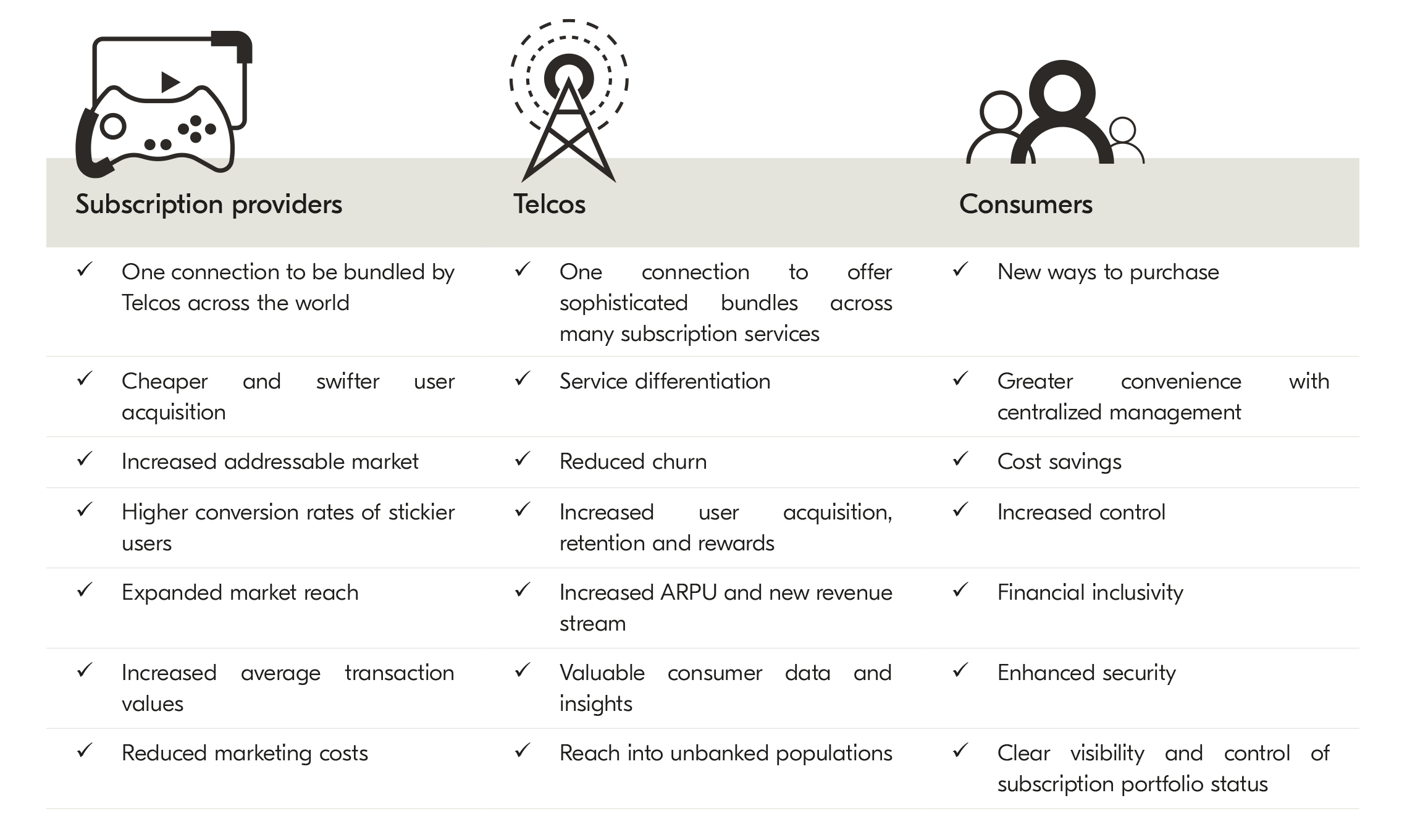

How do subscription content providers benefit?
For content and service providers, subscriptions transform both economics and operating models.
Benefits include:
Consistent cash flow: Steady monthly income supports ongoing content creation, product development and innovation.
Data-driven decision-making: Continuous engagement generates rich behavioral data, enabling better personalization and content planning.
Stronger customer retention: Habitual usage builds loyalty and reduces churn compared with transactional access.
Improved forecasting: Predictable demand simplifies budgeting and long-term investment decisions.
Upsell and expansion opportunities: Tiered pricing, premium features and add-ons increase ARPU over time.
This shift from episodic revenue to ongoing relationships has fundamentally changed how content businesses operate - and how they are valued.
What is a strong example of a content provider pivoting to subscriptions?
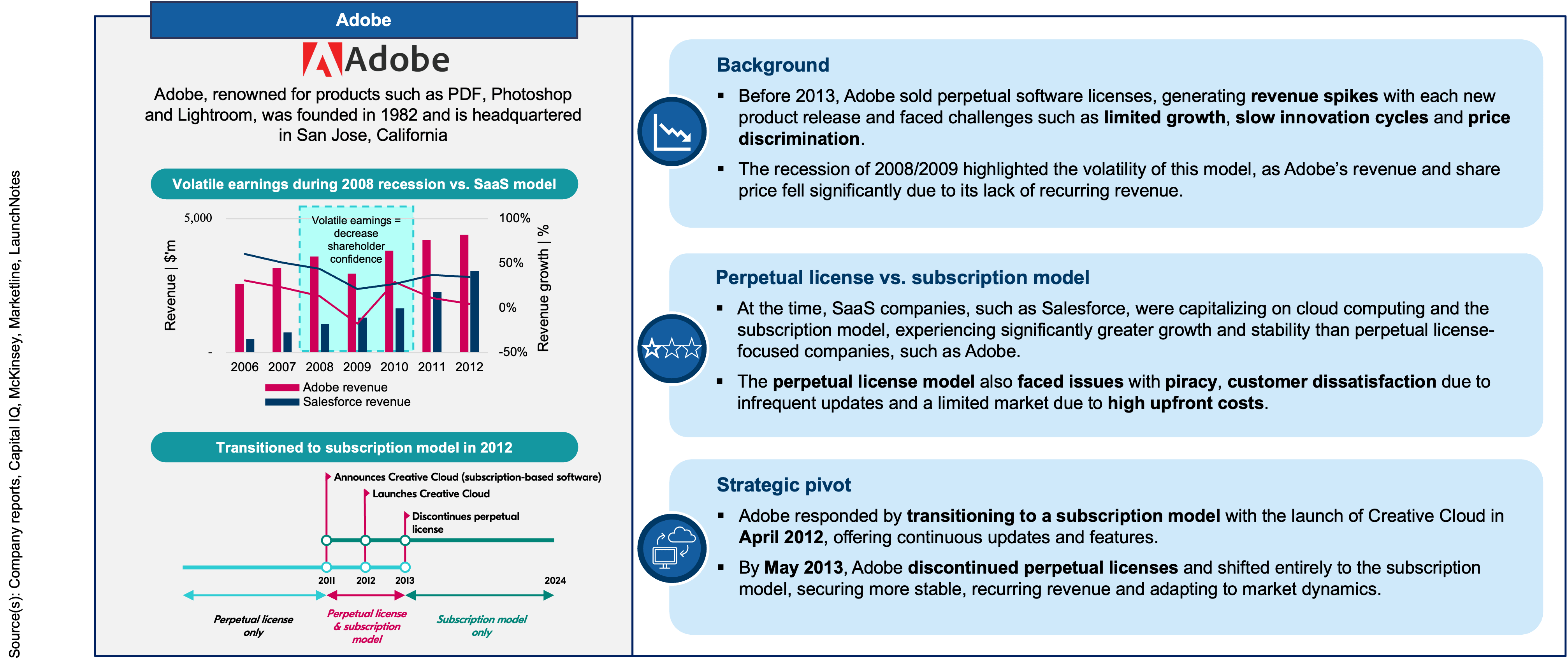
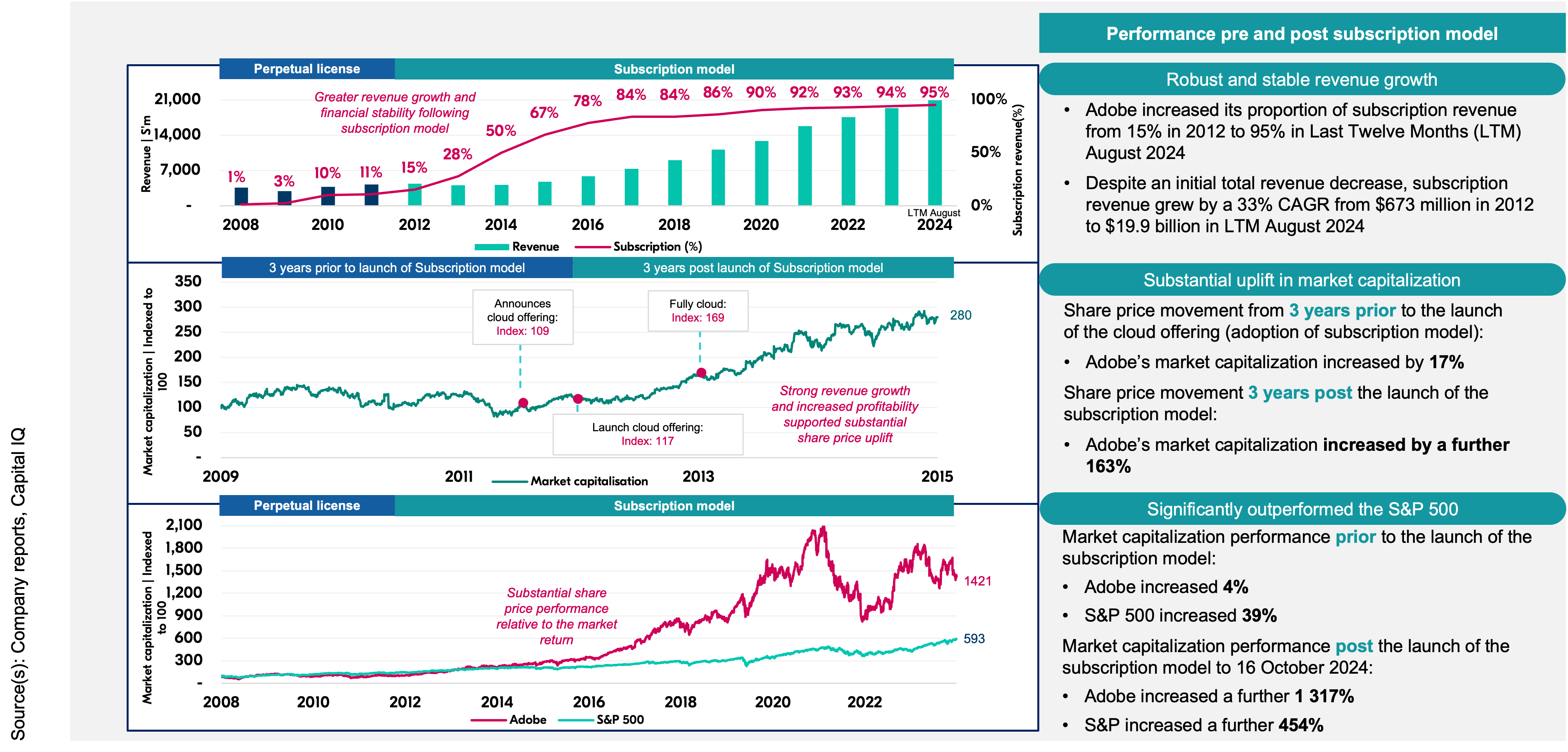
Adobe provides one of the clearest examples of how subscriptions can reshape financial performance.
By transitioning from perpetual software licenses to its Creative Cloud subscription model, Adobe:
Replaced volatile, upgrade-driven revenue with recurring income
Significantly increased lifetime customer value
Improved margin visibility and cash generation
The result was a more predictable, scalable business that markets rewarded with materially higher valuation multiples. Adobe’s pivot has since become a reference point for subscription transformation across industries.

How do consumers benefit from the subscription model?
Consumer adoption is central to the subscription economy’s expansion.
Key benefits include:
Convenience: One-click access removes repeated purchasing decisions.
Affordability: Lower upfront costs make premium services more accessible.
Flexibility: Cancel-anytime models reduce perceived risk.
Continuous improvement: Users receive updates, new features and fresh content without repurchasing.
Personalization: Ongoing data collection enables tailored experiences.
Importantly, these benefits increase engagement and satisfaction - reinforcing the economics for providers and distributors alike.

How do indirect channels benefit from subscriptions?
Indirect channels - including telcos, retailers, and banks - play an increasingly important role in subscription distribution.
Their benefits include:
New revenue streams: Revenue share or commission from each subscription sold.
Increased customer stickiness: Bundled subscriptions differentiate core offerings and reduce churn.
Cross-sell opportunities: Subscriptions add value to existing products (e.g. mobile plans with streaming).
Simplified billing: Integrated billing reduces friction and improves renewal rates.
Actionable insights: Usage data supports smarter partnerships and targeted marketing.
For many distributors, subscriptions are becoming a core tool for customer retention rather than a peripheral add-on.
Who are the key players in today’s subscription economy?
The ecosystem can be broadly grouped into three categories:
Subscription providers: Companies delivering content or services directly to consumers (e.g. Netflix, Disney+, Amazon).
Subscription enablers: Platforms that provide billing, identity and management infrastructure (e.g. subscription management and payments platforms).
Subscription bundlers and distributors: Telcos and platforms aggregating services into bundled propositions (e.g. Verizon, BT, Liberty Global).
Insight: while all three offer exposure, enablers and bundlers often function as ‘picks and shovels’ - benefiting from growth across multiple services rather than the success of a single brand.
Who are the future key players in the subscription economy?
Looking ahead, several groups are positioned to play an increasingly important role:
AI-driven software platforms: AI will increasingly manage pricing, personalization, churn prevention, and bundle optimization.
Diversifying content providers: Streaming platforms expanding into gaming, podcasts and interactive content through partnerships and M&A.
Creator economy platforms: Subscription models enabling direct monetization between creators and audiences.
These players will help shape how subscriptions are created, distributed and managed in the next phase of growth.
Conclusion
The subscription economy is best understood not as a collection of individual services, but as an interconnected ecosystem. Its strength lies in the fact that consumers, providers, distributors, and investors all benefit from the same underlying model.
As growth shifts from subscriber acquisition to optimization, bundling, and lifetime value, collaboration will matter more than competition. For investors, the most compelling opportunities increasingly sit in the infrastructure and platforms that enable subscriptions to scale across industries.
Understanding who the key players are - and how each benefits - is essential to identifying where durable value is being created in the subscription economy.
Stay tuned for the next blog in this series on the 'Investors guide to the subscription economy’: How is the subscriptions economy combating subscriber fatigue?
While the subscription model creates value for many stakeholders, growth is not without friction. As adoption scales, consumers face increasing complexity in managing recurring services. The next post examines subscription fatigue - why it is emerging, how it impacts growth, and what leading companies are doing to mitigate it.
Further reading
Catch up on the previous post of the 'Investor's guide to the subscriptions economy' series:
Part 1: Why is the subscriptions economy a promising investment model for investors?
Part 2: What consumer trends are driving growth in the global subscriptions economy?
Part 5: What is the outlook for the global subscription economy?