
What consumer trends are driving growth in the global subscriptions economy?
The investor's guide to the subscriptions economy – Part two.
What consumer trends are driving growth in the global subscription economy?
Explore the global consumer behaviors driving subscription adoption, including access over ownership, personalization, predictable spending, and bundling.

Executive summary
Consumer behavior has shifted dramatically over the past decade, accelerating the growth of subscription models across industries. Younger generations prioritize access, convenience and flexibility over traditional ownership, while digital adoption continues to increase worldwide. As a result, subscriptions have become a preferred way to consume entertainment, software, education, finance tools, mobility services, smart-home ecosystems, and everyday essentials.
Global surveys show that consumers now manage multiple subscriptions across media, productivity software, cloud storage, wellness, security, and retail replenishment. According to MarketingWeek (2025), almost 70% of UK households subscribe to a streaming service, and adoption is rising in emerging regions as payment options widen.
But the story is not without challenges. Subscription fatigue and budget pressure are reshaping expectations around value, flexibility and personalization.
This blog analyzes the core consumer trends that underpin subscription growth - and explains why these dynamics matter for investors assessing long-term opportunities.

Insight
The strongest investment case in the subscription economy stems from structural shifts in consumer behavior. The combination of digital-native generations, predictable monthly spending patterns and appetite for flexible access, creates durable demand for recurring services.
These behavioral trends suggest sustained global expansion. Risks include subscription fatigue and increased price sensitivity, but well-designed subscription products typically counter these with curated value, tiered pricing, or personalized recommendations. Overall, consumer behavior continues to validate the recurring-revenue model as a compelling long-term commercial model.

Why are consumers shifting from ownership to access?
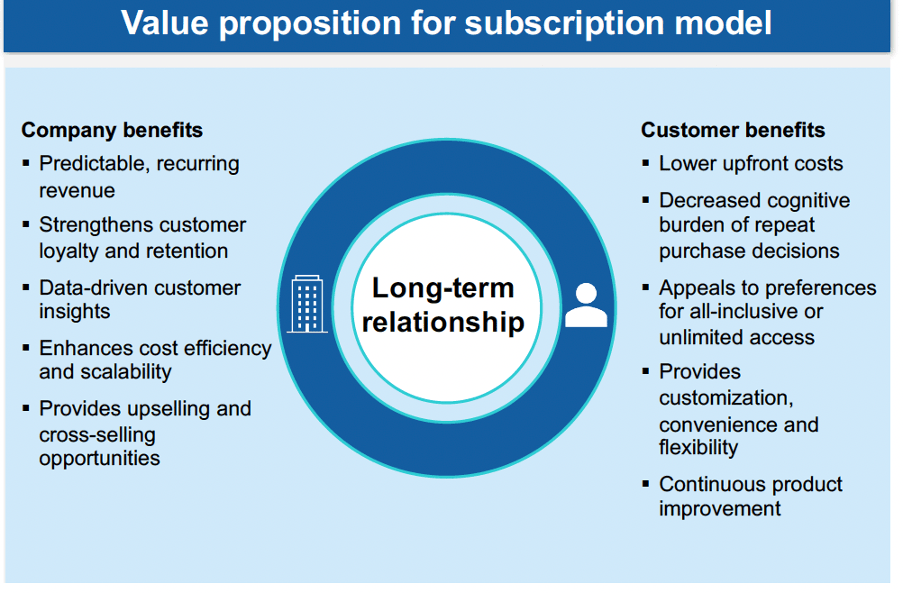
One of the strongest drivers of subscription adoption is the move from owning products to accessing them. Consumers now prefer access-based models for digital content. Younger demographics in particular favor flexibility over long-term commitments. Value for money is also a key consumer driver, with a quarter of people stating that as the main reason for signing up to a subscription service (Internet Retailing, 2024).
Key drivers include:
Lower upfront cost
Ability to switch or upgrade easily
Continuous feature updates
Less friction and no maintenance burden
Immediate access across devices
This behavior extends beyond media into mobility, smart devices, learning, and home security. As ownership declines, recurring-access models continue to benefit.

Why is personalization now essential in subscription models?
Personalization has shifted from a ‘nice-to-have’ to a core value driver. Subscription businesses analyze consumption patterns, behavior and preferences to deliver tailored recommendations, adaptive pricing, or curated content.
Research from McKinsey (2023) found personalized marketing can:
Reduce customer acquisition costs by 50%
Lift revenues by 5 to 15%
Increase marketing ROI by 10 to 30%
Investors should view personalization capability as a key competitive differentiator in subscription businesses.

What is subscription fatigue and how does it affect growth?
Subscription fatigue refers to the psychological burden consumers feel when managing too many recurring payments. Over 60% of streaming consumers feel ‘overwhelmed’ by the number of subscriptions they hold (BRG, 2024)
According to Deloitte’s Digital Consumer Survey (2023):
Price increases remain the number one driver of churn
Consumers increasingly review their subscriptions every 3 - 6 months
Driving factors include budget pressure, rising cost-of-living, identical offerings across providers, and lack of perceived value.
However, markets are adapting through:
Tiered pricing
Free or ‘pause’ options
Bundled offerings
Usage-based models
Loyalty discounts
Stakeholders should monitor how providers mitigate fatigue, as strong retention safeguards long-term value.

How many subscriptions does the average consumer now manage?
Recent global studies show that subscription adoption is both widespread and accelerating:
The average US subscriber now has 5.4 paid subscriptions (Bango, 2024).
Europe, Latin America, and Asia-Pacific show similar patterns, with mobile-first consumers adding lower-cost subscriptions at rising rates.
Globally, over 200 streaming video platforms operate today.
Entertainment is the most active category, but multiple other sectors now represent a significant share of consumer subscription spend.

Which categories dominate consumer subscription spending?
Beyond entertainment, subscription spending is diversifying rapidly.
Key categories include:
Cloud storage and device backup
Security and identity protection
News and professional information
Fitness, wearable health data, and wellness apps
Education and language learning
Premium social and productivity tools
Home security and smart-device ecosystems
Financial tools, investment platforms, and algorithmic guidance
Retail replenishment (e.g., razors, coffee, cleaning supplies)
Consumers increasingly stack subscriptions in multiple ‘pillars’ of their daily lives: productivity, wellbeing, entertainment, learning, and home management.

How do behavioral trends translate into subscription growth?
Behavioral economics supports recurring-revenue adoption:
Predictable monthly spending acts as a budgeting tool
Consumers value frictionless convenience
Personalization increases perceived value
Engagement habits lead to ‘sticky’ behaviors
Network effects and ecosystem lock-in strengthen retention
These dynamics underpin long-term demand and explain why recurring-revenue companies outperform transactional models in growth, retention and margins.

Conclusion
Consumer behavior is the engine of subscription-economy expansion. Preferences for access, convenience, digital-first experiences and personalized services have created a durable foundation for recurring business models across the globe. While subscription fatigue and pricing pressure may challenge some categories, the underlying shift in consumption is structural.
These behavioral trends validate the longevity of subscription models. Businesses that deliver clear value, personalized experiences and strong retention are best positioned to benefit from global growth. As demand broadens into areas such as AI tools, smart-home ecosystems, financial services, and wellness, we should expect continued momentum across the subscription economy.
Stay tuned for the next blog in this series on the investor's guide to the subscriptions economy: How are subscriptions embedded in everyday life?
Consumer preferences explain why subscriptions continue to grow, but their true economic power becomes clear when we examine how deeply they are embedded into everyday life. Subscriptions are no longer occasional purchases; they are infrastructural to daily routines. The next post explores how subscriptions now underpin work, entertainment, mobility, health, and the connected home, and what that ubiquity means for investors.

Further reading
Catch up on the previous post of the 'Investor's guide to the subscriptions economy' series - Part one: Why is the subscription economy a promising investment model?