
How are subscription bundles evolving from simple packages to complex ecosystems?
The investor's guide to the subscription economy – Part 8.
Examine how subscription bundles are evolving from simple add-ons to complex, platform-led ecosystems - and the implications for growth, churn and ARPU.

Executive summary
Subscription bundling is undergoing a fundamental transformation. What began as simple, cost-saving packages has evolved into sophisticated, platform-based ecosystems that give consumers control, flexibility and visibility across multiple services. This shift is driven by rapid growth in subscription volume, rising customer acquisition costs, and increasing subscriber fatigue.
Bundling now plays a central role in reducing churn, improving lifetime value and simplifying subscription management. Importantly, this is a rare dynamic in which consumer demand and brand economics are closely aligned. As bundles become more sophisticated, technology platforms that enable discovery, management, and personalization sit at the center of value creation.

Insight
Subscription bundling is no longer a pricing tactic - it is a distribution strategy and a retention engine.
As direct-to-consumer acquisition becomes less effective and more expensive, brands are shifting toward indirect channels such as Telcos, banks, retailers, and platforms with existing reach, billing relationships and trust. Bundling lowers CAC, increases LTV, and materially reduces churn.
The most compelling exposure is not limited to content brands themselves, but to the technology and platforms that enable bundling at scale - the infrastructure that underpins discovery, billing, management, and personalization across ecosystems.

Why did subscription bundling rise in the first place?
The subscription economy has expanded rapidly across entertainment, software, health, mobility, retail, and financial services. While this growth has created choice, it has also created complexity.
Consumers now manage multiple apps, logins, payment methods, and renewal cycles - leading to growing frustration and fatigue.
Bundling emerged as a response to three converging pressures:
Subscriber fatigue caused by too many standalone subscriptions
Rising churn, particularly in fragmented markets like streaming
Escalating acquisition costs, making direct marketing less sustainable
By grouping services together, bundling simplifies decision-making, reduces friction, and makes subscriptions “stickier” for both consumers and providers.

Why are brands accelerating their shift toward bundling?
The economics of direct acquisition are deteriorating.
Recent industry data highlights the challenge:
48% of subscription executives say digital advertising is delivering diminishing returns
53% believe direct acquisition is no longer a sustainable growth strategy
46% describe their current DTC spend as a “black hole”
Looking ahead:
88% of subscription brands expect customer acquisition costs to rise in 2025
One in three expect a significant increase
77% are prioritizing indirect acquisition this year
Rather than competing in saturated ad markets, brands are partnering with organizations that already have scale, trust and billing relationships - including Telcos, banks, retailers, loyalty platforms, and employee benefit schemes.

How widespread is bundling today?
Bundling is no longer experimental - it is becoming the default route to market.
Recent data shows:
90% of subscription brands are already bundling or plan to bundle in 2025
27% participate in super-bundling platforms (e.g. Optus SubHub)
44% bundle or plan to bundle through banks and financial institutions
44% bundle or plan to bundle with retailers
This shift reflects a structural change in distribution, not a temporary tactic.

Does bundling actually improve performance?
Yes - across the metrics that matter.
Compared with direct acquisition:
72% of brands say indirectly acquired subscribers have higher lifetime value
86% say indirect channels unlock customer segments they can’t reach directly
One social-media subscription brand reported a 28% drop in CPA after pivoting to bundling and cross-selling
Bundling also addresses churn. In fragmented streaming markets, the ‘subscribe, binge, cancel’ behavior is common. When services are bundled, churn rates have been shown to fall from ~8% to ~3% in some cases.
As one executive summarized:
Bundling increases customer value, customer retention, revenue growth, cross-selling, and provides opportunities for competitive differentiation.

How have subscription bundles evolved over time?
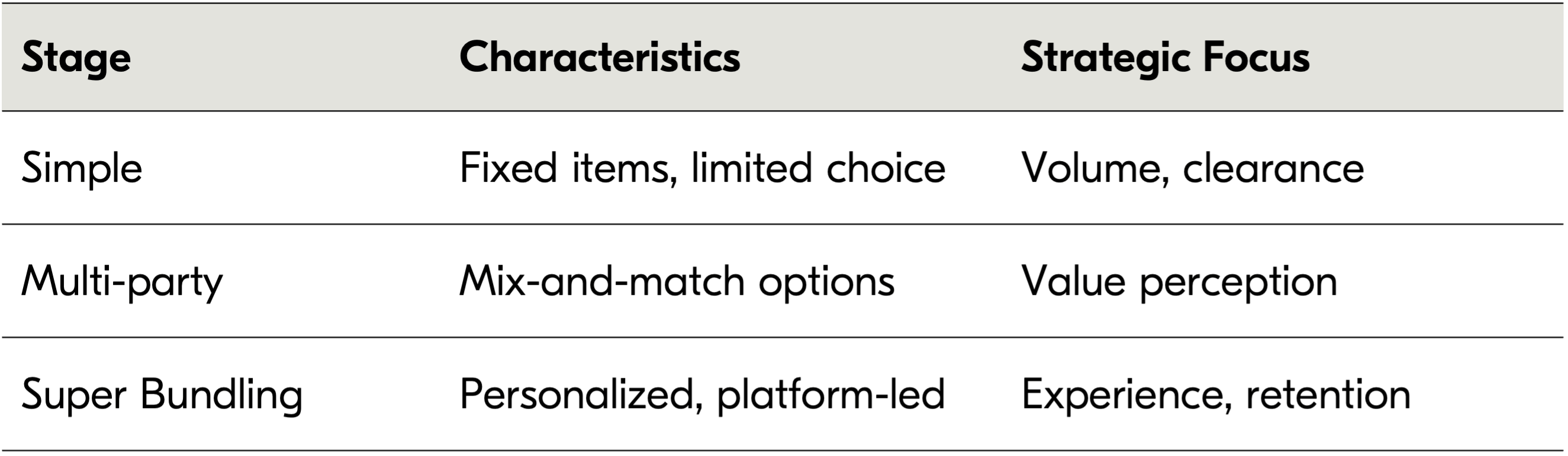
Subscription bundling has progressed through three clear generations, each increasing in complexity and strategic importance. What began as a simple way to increase order value has evolved into a strategic tool for retention, differentiation, and ecosystem control.
Understanding this evolution is critical, because each stage increases the importance - and value - of the technology that enables bundling at scale.
Generation 1: Basic Bundles - Packaging for volume
What do Basic Bundles look like?:
First-party product bundled with a single third-party product
Fixed, all-or-nothing packages
The earliest form of bundling was simple and transactional. Brands grouped two or more products together into a fixed package, typically with a small price incentive, to increase volume and simplify purchase decisions.
Examples: fast-food value meals; shampoo and conditioner sold together; or early software suites such as Microsoft Office, which bundled Word, Excel and PowerPoint into a single product offering. In telecommunications, this approach appeared in the form of basic phone-and-TV packages.
Goal: increase average order value, move inventory, and drive adoption through perceived savings.
Impact: While effective in the short term, these bundles were rigid and offered little differentiation. Consumers either took the bundle or left it, with no ability to tailor or manage components.
This generation of bundling was product-led, not customer-led.
Generation 2: Multi-Party Bundles - Flexibility and perceived value
As subscription services grew and digital distribution matured, bundling entered its second phase. One core product is bundled with multiple third-party services, offering greater flexibility - components available separately or together.
What do Multi-Party Bundles look like?: Brands began combining their core products with multiple third-party services, introducing greater flexibility and choice.
Examples: Telcos led this shift. Mobile and broadband providers moved from ‘triple play’ bundles (mobile, broadband, TV) to ‘quad play’ offerings that incorporated 4G and later 5G services. Over time, these bundles expanded to include third-party streaming services such as Netflix or Spotify, offered either at a discount or as a limited-time inclusion.
A widely recognized example is Verizon’s inclusion of streaming services within mobile plans, allowing customers to access entertainment subscriptions alongside connectivity through a single provider. Similar strategies were adopted by Sky, BT, and other operators globally.
Goal: Improve value perception and reduce churn by tying multiple services to a single provider.
Impact: Higher satisfaction and lower churn, as customers perceived greater value and convenience without rigid commitments.
However, management remained fragmented. Subscriptions were bundled commercially, but not operationally - users still managed services separately.
Generation 3: Super Bundling - Personalized, platform-led
The current phase of bundling represents a structural shift rather than an incremental improvement.
What do sophisticated Super Bundles look like?: Super bundling aggregates multiple digital and physical services into a single, consumer offer. They are flexible, personalized, and increasingly AI-driven.
Examples:
Amazon Prime is one of the earliest and most successful examples. What began as a shipping subscription now includes video streaming, music, gaming, cloud storage, exclusive retail offers, and more. The value of Prime lies not in any single service, but in the breadth and integration of the ecosystem as a whole.
Apple One follows a similar model, bundling Apple Music, TV+, Arcade, iCloud, and Fitness+ into tiered plans. Crucially, Apple One integrates deeply with Apple’s hardware and operating systems, reinforcing ecosystem lock-in and long-term engagement.
Telco-led subscription hubs represent another powerful manifestation of Super Bundling. Platforms such as Optus SubHub in Australia allow users to discover, activate, pause, and manage multiple third-party subscriptions - including Netflix, Amazon Prime, and Microsoft 365 - in one place, with a single bill.
Goal: In these models, bundling is no longer about price alone. It is about control, visibility and flexibility. This is designed to optimize customer lifetime value, increase ARPU and deliver personalized, long-term engagement.
Impact: Lower churn, higher loyalty. Consumers can adjust their subscription mix as needs change, without cancelling entirely or losing access to the ecosystem.
This evolution is underpinned by advances in technology, entitlement management, and increasingly AI-driven personalization.
Summary of the evolution

Why is Super Bundling becoming essential?
Nick Maynard, VP of Fintech Market Research at Juniper Research, captures this inflection point:
As consumers grow increasingly weary of endless subscriptions, providers must deliver distinctive value to maintain growth. Simply relying on hybrid models that mix ads with subscription fees while raising prices is not a long-term solution, and risks alienating already fatigued customers.
Super Bundling meets this need by:
Centralizing subscription discovery and management
Allowing users to sign up, pause, resume, and swap services
Providing a clear, consolidated view of spend
Consumers consistently express higher loyalty to providers that offer these capabilities - and many are willing to pay more for them.
As subscription volumes increase, management complexity becomes the primary pain point. Consumers want fewer apps, fewer bills, and fewer decisions - without sacrificing choice.

What does this evolution signal?
The progression from basic bundles to super bundling ecosystems signals a structural shift in where value is created.
In early stages, value accrued primarily to product owners. In the current phase, value increasingly accrues to platforms that:
enable aggregation across multiple providers
manage billing, entitlements and lifecycle events
support personalization and flexibility at scale
As bundling becomes more complex, the strategic importance of enabling technology grows. These platforms benefit not from the success of a single subscription service, but from the expansion of the entire subscription economy.

Conclusion
Subscription bundling has evolved from a simple packaging tactic into a core pillar of the modern subscription economy. As markets mature and fatigue increases, the ability to simplify, personalize and manage subscriptions at scale becomes a competitive necessity.
For brands, bundling offers lower acquisition costs, higher retention and stronger economics. For consumers, it delivers control, clarity and convenience. The greatest opportunity lies in the platforms and technologies that enable complex bundling ecosystems - the infrastructure that sits beneath long-term subscription growth.
Stay tuned for the next blog in this series on the 'Investors guide to the subscription economy’: Which subscription niches are currently underexploited and represent high-growth opportunities?
As bundling matures, it is revealing where future growth will concentrate. Some subscription categories are already saturated, while others remain underdeveloped or poorly served.

Further reading
Share your feedback
Discover